Showing posts with label Artist Interviews. Show all posts

Wednesday, August 7, 2013

Artist Interview with Susan Shie, Part 2

Welcome to (the much belated!) Part 2 of my interview with quilt artist Susan Shie!  If you did not catch Part 1, go check it out, then come back here, see the rest of the questions she chose, and read all of her insightful answers! Plus, you get to see a quilt she created for the SAQA Benefit Auction this year, which is pretty thrilling.....


Coloring in the big piece is really relaxing.  I usually start with yellow and go to darker colors from there, since this paint is transparent, like watercolor.  I love how it looks at this stage, very fresh!

Do you have a specific idea of the story you'd like each piece to tell, or are you hoping viewers will have stories of their own ready to inhabit your work? 

I remember being upset at times, when a student somewhere would write a paper about one of my pieces and base their information just on what they saw, rather than what I’d written in my own statement about that piece.  I’ve learned to let people have their own stories of my work, even if their ideas of what I was after are all different than my original intent.  I know many people won’t even read one thing on my works, and that others’ interpretation of my symbols will be way off from my own.  I can’t waste my time expecting others to listen to what I say, and it’s a very creative process, when they take all the crazy disparate things I put together visually and make their own logic out of it. It’s all good! 
I’m staring at the painting, which has a lot of colors on it already and will tell me what it needs where now.
Do you have any concrete advice about how to do away with artist's block? 

Draw every day.  I invented a little process, in which you go into your studio and sit down and draw and write whatever comes into your head, for 10 minutes only, then you quit.  I do it with my students, and we use children’s markers, so they can relax and just play.  I call this Library Time, and no one talks while we work for the 10 minutes.  I find it makes me feel centered into myself really well, and it brings up lots of creative thoughts, though whatever pops into your head is what you just let come through. It’s a form of channeling your inner thoughts and creativity, and you become loosened up.  Works like a charm, and it’s free.  No big book to read on how to be more creative.  Just do it, any time you want to get unstuck.  Priming the pump! 
I usually write with my airpen and fabric paint as a first and last draft, like writing a letter.  But here I’m copying the full inaugural speech, and later I added the full inaugural poem, for “American Pie.”
Do you place a high value on the role of humor in fine art?  How do you attempt to incorporate humorous elements into your own work, and what would you say is your response when you get a laugh from a piece by another artist? 

I know people sometimes think my work is funny, but I prefer to push it to being edgy, not humorous.  I am a little fussy about that, and I don’t like it when people say my work is cartoonlike or whimsical.  But I know I have to own those terms, when people see them.  So I work to keep the effect I want in my drawing style, which is simplified, not realistic.  I think you can fall off the balance of edgy into the abyss of cute or funny really easily, and I don’t want to.  But then, that doesn’t sound like I’m just letting my creativity out, does it?  We can’t turn off all our thinking, but we can learn to open up and let things come out … even if I do care to make sure my images are not whimsical.


“American Pie: 6 of Potholders (coins) in the Kitchen Tarot,” full view, ©Susan Shie 2013.  Sewn painting on cloth. 60”h x 90”w.  Read the long artist’s statement and find many pix of this piece at http://www.turtlemoon.com/gallery13/AmericanPie.htm.

What do you believe about the role of originality in art? Do you think it is important to always be unique, or is it best to just make the work and not worry whether it will be similar to something that someone else may be doing? Have you ever felt that your work was not original enough, or conversely, that a desire for total originality was getting in the way of your work communicating effectively? 

I’m sure I’m obsessed with being original, but at least I can honestly say I don’t think about it consciously while I’m working, and maybe that’s true of my need to have my art look edgy and feisty instead of cute.  On a very deep level, I MUST have a look that’s mine.  Maybe this comes from art school, where students learn to never, ever copy each other’s ideas.  Or at least, that is my memory of it.  I know I don’t care that some of my students copy my style. That’s fine, because they paid me to teach them.  Some of them just enjoy working my way, but those who want to get known for their own look will have to push through all the stuff they learn in classes and come up with that look.
If someone saw my work and told me they thought it was someone else’s work, I’d be miserable and really have to rethink what I’m doing.  I want you to recognize my work among a bunch of artists’ work, every time, once you’ve seen my work.  Yeah, that’s ego for you!  But it is truly important to me and always has been.  I don’t need to brag about my art or anything like that.  I just want to know you know it’s mine. 
“American Pie: 6 of Potholders (coins) in the Kitchen Tarot,” detail, ©Susan Shie 2013.  Sewn painting on cloth. 60”h x 90”w.
 You made a conscious switch from doing very labor-intensive, physically complex quilt art to your current more streamlined airbrushed work that includes only a few carefully chosen embellishments.  Do you think the old way and the new way of working produce or come from two different states of mind? Do you ever miss the old method, and have you broken from your current method to make any new work in the old style? 

They are from the same state of mind, in terms of creative motivation, but along with the taming of the airpen for fabric paint and cloth and the numb fingertips from hand sewing, I also consciously realized I choose to be a painter much more than a quilter/sewer.  I only miss the old way of doing all that hand work when I’m riding a long time in a car or sitting still to watch late night tv sometimes, as I could be sewing.  Except it would wreck my hands, which I try hard to honor by not overdoing repeated motions.  I think the numbness is carpel tunnel syndrome. I would only do the old style again if someone paid me the big bucks to do it.  My hand stitched and beaded quilted paintings were $20/sq inch, and my machine quilted paintings are $4/sq inch.  I think the hand work is actually way more than five times the effort though.  I would have to really, really pace myself to do that again, but money talks!  I have a middle size piece frozen at half hand stitched, and I haven’t been able to stomach finishing it, from when I left it sit in 2006.  Instead I restarted a different, much larger piece of the same Kitchen Tarot piece, using my new methods, and finished it in two months.  I knew it would have taken a half year to finish the smaller version of “The Food Scales: Justice in the Kitchen Tarot.” 

“YaYas Lunch.” ©Susan Shie 2013.  Sketchbook drawing. Ink and colored pencil.  11”h x 17”w.

You use an incredible number of personal symbols in your work, and I am curious about how they have entered into your art over time.  Have you stuck with most of the same symbolic elements for a long time, or are different meaningful animals, people, objects and patterns continually coming into your head? Lastly, do you choose them consciously or do they just sort of start appearing and at some point you realize that a certain symbol has chosen you? 

They have just kept accumulating over time, and I think I figure them out, usually very playfully.  I think that having to pick a kitchen object to represent the traits of each Kitchen Tarot major arcana card really escalated that growth of symbolic vocabulary.  Maybe the trickiest one was figuring out that the pressure cooker could be the Tower card, as I had to think of something in the kitchen that had been dangerously ignored and eventually explodes, which is what the Tower card is about. 
“Home Blessing Song #1.” ©Susan Shie 2013. Sewn painting on cloth. 12”h x 12”w  made for the 2013 SAQA online auction.
Your studio is in Ohio, and as far as I can tell, you have a very un-New-York personality, but I definitely adore one of your pieces that I saw in "Masters: Art Quilts Vol. 1," "Tropical New York." I'm curious to hear your thoughts about New York, what it's like to create work inspired by this city, and urban themes in general.  

I lived in New York City for six months in 1988, on an artist residency with the Ohio Arts Council, and Tropical New York is about some adventures I had there, especially when Spring came to the city.  Jimmy brought our daughter Gretchen and two of her friends, all 17 years old, on their Spring Break, and they stayed in my Long Island City apartment, 3 blocks from my studio at PS #1.  Long Island City is on the east bank of the East River, right across from Midtown Manhattan, one subway stop away.
“The Big Dig.” ©Susan Shie 2013.  Painting on cloth.  Fabric paint, applied with brush and airpen.
18.5”h x 22.5”w.  This is a piece I made as a demo for several of my processes, in my Turtle Art Camp in March, 2013, right after clearing out the studio.
 I had a big studio in PS #1, when the studios were still in bad shape, but they were working on the building.  This was WAY before MOMA used PS #1 as its building, while the museum in Manhattan was being renovated.  It was the only time in my adult life that I lived alone, except for when I had my granny pad in Cleveland in 2004-06, to take care of Eva at my kids’ house during the week, while my daughter was at work.  The NYC period was full of exploring the city, making lots of my work, and interacting with artists from all over the world.  I could have stayed there, if I’d had 3 jobs to cover all the expenses that were paid for me during that amazing residency!! 
“Downtown Wooster Saturday Morning,” full view, ©Susan Shie 2013.  Painting on stretched canvas. Acrylic and ink. 18”h x 24”w.  Collection of Lisa Wagoner, Wooster, Ohio.
 I love that piece. It’s from a more reckless time in my work, when I was doing a LOT of painting with abandon on lots of crazy fabrics, and I was still using 3-D figures I sewed together, painted and stuffed and embroidered all over.  There are snakes to represent the subways, some of my first Buddha Girls, to represent the Voice Meditation class I took at PS #1 with the Dutch artist’s wife.  (There were something like 35 artists who had studios there, mostly from other countries, but there were 4 of us from US states.  Ohio had one of the best arts councils in the country then, and still does, but all of them have lost most of the funding they had back then.  They sent me to China for a month in 1990, too!)  
“Downtown Wooster Saturday Morning,” detail view, ©Susan Shie 2013.  Painting on stretched canvas. Acrylic and ink. 18”h x 24”w.  Collection of Lisa Wagoner, Wooster, Ohio.
Do you have any extremely talented artist friends whose work you'd like to plug here on the blog? They don't have to be fiber artists, just super cool folks who could use a little blog love.  

I love the work of Suzanne Fisher of Cincinnati, who’s a painter, mixed media artist, and mosaic muralist.  Her work is amazing.  She also had an artist residency at PS #1 in New York, the year before me, and we became good friends over it. To me her work is edgy and often about women, which is my own thing, too.  I have never collaborated with Suzanne, but would love to! 
This is a mosaic fountain by my friend and genius, mixed media artist Suzanne Fisher of Cincinnati. http://suzannefisherart.com/home_main.html
I am an artist who "cannot draw," and I am interested in the ways that artists who want to make work which is representational but not strictly realistic can develop a visual vocabulary that does two things, both of which I think your work does very well.  The first is communicate clearly (i.e., figuring out how to draw hand gestures, faces and body interactions that viewers will be able to read easily even if they do not conform to the laws of reality). The second is visual appeal (i.e. why do I adore some artists who work in this style of not strict realism, like you, Lynda Barry and Pamela Allen but absolutely loathe other artists' work that can be said to follow the same conventions?). I would love to hear your thoughts about the importance of communication and visual appeal within the work that you do.

Thank you for your supportive words!  I believe that art is mainly an act of communication, and in my life, communication is what it’s all about!  I believe that all of us can draw just fine, but most of us dropped drawing at some point, so for those many people, their drawing skills NOW are probably worse than when they quit drawing, as a child.  Children are geniuses in many ways!  But they learn to fear being wrong, and they hate to be ridiculed.  They often shut down anything they don’t have to do, that might get them picked on. 
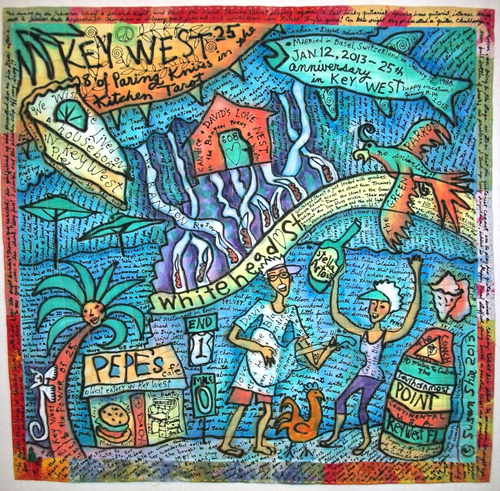

“Key West25 : 8 of Paring Knives (swords) in the Kitchen Tarot.”

I used to draw realistically a lot, but I also did a lot of photography, and finally I decided that my camera can do the realism, while I busy myself with making more intuitive art.  I love to draw, and I know that if I copy from a sketch I’ve made and love, it gets wrecked with stiffness. I still make life drawings, looking at things and drawing them realistically. That’s how you learn!  You need to just draw, to accept what comes out, in order for it to be alive.  It’s good to stand up to draw, to have some music on, to move with that music while you draw.  And especially it’s best to turn on the negative thinking.  It makes me happy to draw and paint and write and sew!  I think when we’re happy, our bodies and minds get a chance to do some healing and balancing.  So then: art is good for you!
“Turtle Moon Sign.” ©Susan Shie 2012.  Sewn painting on cloth.  22”h x 24”w.
As for getting the gestures right, it helps to draw from real life when you can.  You educate yourself when you really LOOK at what you’re drawing.  And practice makes perfect!  I have many, many years of art school behind me, and some of that stuff I recognized as balognie: the rules part.  But the golden part was making tons of drawings from life, developing the skill of being able to communicate what you see.  So then, like a jazz musician, you can scat when you draw.  You can syncopate the look, like how a jazz player stylizes the music, bending the music rules to their desires.  I think what you’re talking about responding to could be called syncopated drawing.  Or Jazzy Art, or Sassy Art!  Sassy is a nice word, and I’ve got a few little classes on my site I’m now offering with that word in their titles.  Sassy Drawing, Sassy Painting, Sassy Art Quilts, or something like that.  It’s making art with a real sense of freedom many people sadly don’t realize they would love feeling. 


©Susan Shie 2008. This is the largest painting I’ve ever made.  Hand colored house paint, brushed onto wooden garage door.  Approx 8’ x 16’, plus trimwork.  Finished about a week before the Presidential Election 2008.  Statement and large images at http://www.turtlemoon.com/gallery08/Garage%20Door%20Mural%20full.htm.

A GIANT thank you to Susan Shie for infinite patience with the ridiculous delay in getting this interview published, it was an absolute pleasure to work with you, and to learn all about your artistic process and your life philosophy!

Wednesday, June 26, 2013

Artist Interview with Susan Shie, Part 1

Today's interview subject is art quilter Susan Shie, who makes gigantic, colorful and incredibly uplifting quilts full of drawings and thousands of words of text. She creates her imagery using an airbrush and a new-to-me tool called an AirPen. Looking at the pieces in Susan's Kitchen Tarot series has made me think in a new way about how artists can share all kinds of ideas with all kinds of people using imagery that is simultaneously incredibly personal and somehow also universal. (by the way, you can totally buy a deck of cards based on some of the quilts, though you will have to wait a while longer for the full set!)

Here is the first half of my interview with Susan Shie: 


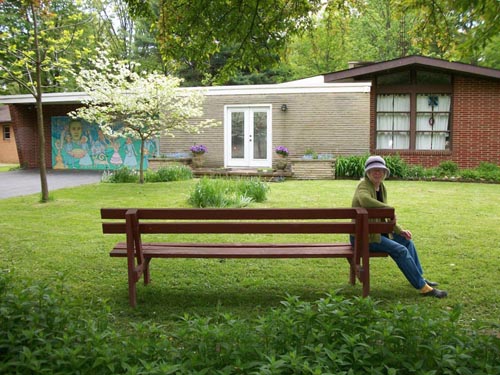
Here you can see the Obama garage door mural and Libby in the livingroom window, and some pretty nice Spring flowers at our place. Welcome to Turtle Moon Studios, my home. www.turtlemoon.com

Describe Your Workspace - is it in your living space or separate? Do you have a preference one way or the other? Is there anything your setup doesn't allow or that you have to do in a weird way? Have you come up with any ridiculously clever ways of working with the space you have available to you?

My studio has to accommodate not just me, but all the students I have living with us for a week, each time I have a Turtle Art Camp (TAC), which I’ve been doing since 1994.  This art biosphere setup can have up to 4 students, as we have 4 student bedrooms.  My studios are in the basement, so the students need to be able to do stairs, but they have 24 hour access to working, including the 6 hours of class I give them each day.
So my studio has to be pretty tidy.  I’ve just done a massive Big Dig cleanout, so it’s the nicest it’s been in years, and the students and I have plenty of elbow room again!  Actually I can even have 5 students, but 2 of them would have to share a bedroom with twin beds, which means they have to know each other well, before they come here.  The other rooms all have full size beds, so are one person rooms.
It gets a little tight with 5 students in the studios, doing painting with brush, airpen, and airbrush, and then maybe sewing one of their paintings from the week.  It’s a very different kind of experience, coming to live in the home of strangers for a week, so I try to put pix from camps on my Facebook page now, and had a running diary on my website, from 1997 on, way before there was the word “blog,” and that was my attempt to get people to feel like they sort of knew me, enough to come here and trust me!  You can read about Turtle Art Camp on my site at www.turtlemoon.com/classes/tcamp.htm.

My dog Libby and me. Early 2013.

What is your personal working balance between planning and spontaneity/accident? Does this balance look the same for each project you undertake?

In the OLD DAYS, I prided myself in just drawing on the piece, with no sketches made ahead.  But my work got more and more complex, especially when I ditched the hand sewing I’d been doing more and more and more of, and took up doing the Crazy Grid machine quilting I do now, which instantly meant I had time to work much larger.  With that came very complex compositions, and because of them, I started sketching a lot before pouncing on the cloth.  I sketch many images, zeroing in more and more on who will be in the piece, what they’ll be doing, and how they relate to each other.  What props they’ll have, how they feel, etc.  By the time I think I’m ready to use my airbrush and black paint and draw right on the big cloth, I’ve got the plot thickened well usually.
Then I fold my favorite of the many sketches into fourths, and draw a yellow overliner marker line to divide my big piece of cloth also into fourths so I can roughly judge how much of my composition goes into each quadrant, and especially where the very first marks will fit on the divided space.  I don’t want to LOOK at the sketches when I draw on my giant cloth piece, because I want to keep my drawing style fresh.  The hardest part is always getting the very first image onto the cloth, where it should be and at the right size.  Then, if I blow it, I have to adjust all the images’ sizes, etc, to make it all fit.
There are times when I do one sketch and have it.  Then there are the times it takes 15 sketches before I’m ready to paint in those black airbrush lines that can’t be changed!  Good thing I love to draw!

My studio holds 4 to 5 students and me, for my Turtle Art Camps, the weeklong art biosphere intensives I’ve held since 1994 here in Wooster, Ohio, in my home.

Do you incorporate any materials or techniques into your art that are not normally thought of as art supplies? What about these items makes them appeal to you personally?  How do you use them, and how did you discover this unexpected artistic use?

I think this would be my writing.  Most people don’t write all over their paintings.  I do, and I would feel sad if I couldn’t do that, because I love telling stories.  I spend way more time writing on a piece than sketching, drawing, and painting in the imagery, and I write as a first draft right on the cloth, not making that a copy from a planned script.  I do copy other people’s speeches or parts of them at times, but that’s not as much fun.  It has to be a really good speech, historically important, for me to want to do it that badly.  I think I got to writing in this overall style, that feels kind of like a screen door’s overall screen pattern, when I dumped doing all the tiny hand stitching I was doing for years and years.  Now I write with my airpen and black fabric paint, telling my own stories, giving news about current events and lessons from history, reporting on all kinds of things that fascinate me, and knowing that the words have to hold up as texture, because a lot of people will never read any of it.  These words take the place of the old tiny hand  stitches, giving the surface a nice pattern, but these words absolutely have to be meaningful to me.

Otis the cat studies some of the sketches I’ve made for “American Pie,” before I go downstairs to airbrush a very large, 60 x 90” white cotton cloth panel for the actual art piece.

Are there any media or methods that you know are definitely NOT FOR YOU? Did you discover this the hard way or do you know without having to find out? (feel free to tell some horror stories!)

I’m not interested in doing home ec style sewing at all anymore.  I had to do that from my girlhood 4H and home ec days, up through the years of making all our clothes and even making custom, very tailored leather garments in Jimmy’s leather shop in the late 70s.  I know that kind of sewing very well, as my mother was a great seamstress who taught me with great commitment and patience.  But my sewing now is art sewing.  It has to have the integrity of holding together well and looking like I want it to.  But I want my sewing to fit with my drawing and painting styles, and part of that is that it needs to look unique. And the technique needs to fascinate me, not drag me along with its rules.  I want people to look at my sewing and see how simple it is, and tell themselves that this can’t be what’s special about my work.  I want them to be compelled by the imagery and stories, not the sewing.  The sewing should sink into their background thinking, while the story sucks them in. I’m glad I understand sewing rules and techniques well, so I can pick what I want to use and know what I have to keep of the rules and what I can ditch.

Going from small sketches to huge cloth painting is scary, when you’re freehanding it, at least scary for the first marks, which set the scale for all the drawing.  I try to not look at the sketches while I draw with my airbrush, so the lines stay fresh and free. There are many albums of my works in progress on my facebook page Susan Shie Turtle Moon Studios.

Are you a stickler about your particular medium, or are you happy to cheat, borrow and steal from other disciplines whenever it seems like a good idea?

Hmmm.  Let’s say I am a pirate, going where I feel like going.  When I was in grad school, it never occurred to me to take Surface Design classes in the School of Art at Kent State.  I was in Painting.  So I did my paintings off stretchers, on fabric, not even thinking of them as quilts at all.  They were soft paintings.  If I’d been in Surface Design, I’d have found some way to work differently from the other grad students.  I am contrary!  But I had made a conscious choice in my undergrad years in the late 70s, to merge my “women’s work” sewing with my studio painting, as a feminist statement, for which I credit the feminist artist and teacher Miriam Schapiro, who was an artist in residence at The College of Wooster while I was a student there. She was really supportive, going around the country, pushing women to make a movement of Women’s Art.  I loved that, and I still love it!  My school was ablaze with feminism at that time, and when I went to Kent State for grad school, I was very active in bringing Women’s Art to the School of Art.

Libby and I relax, and I get to take off my respirator for a break, after drawing the whole piece with black paint and my airbrush.  You can see that the image has changed a lot, from the last sketch in my book.  I like that it’s really the next iteration of the sketches, only way big and permanent.

Are you currently having a passionate love affair with a particular medium or technique or concept, and would you care to share all the steamy details?

I’ve been in love with how I currently work since 2003, when I started using my airpen to write on my work with black fabric paint pushed by a tiny airpump through a surgical needle.  It doesn’t stress your hand, because you don’t squeeze to get the paint out.  I had been dreaming about that sharp, crisp, rich black line since I was a young painter in junior high school.  My husband bought me an airpen for Christmas 2002, and I almost sent it back, after failing to figure it out and not finding anyone who was able to use it on fabric with fabric paint well.  I gradually worked out many problems over the years, and am still having ah-ha moments.  I love my airpen and my airbrush both, and can’t imagine which one I would give up, if I had to let go of one and keep the other.  I’d never guessed I’d be using airpowered art tools, but they are both so natural to me now, that I never want them to leave me!
In 2006 I realized that the intensive hand sewing and beading I’d been doing so long had caused my fingertips to go numb.  I’d been experimenting with machine quilting, which I dubbed “crazy grid” work, because I prefer a rather intuitive, wobbly grid, which is not marked and tends to go all over the place with no rhyme or reason.  With the numb fingertips, I couldn’t bead well at all, and I decided that I am a painter, not a quilter really.  I made my first large machine sewn piece in 2005 and in 2006 dropped the hand sewing almost completely, only sewing a line of perle cotton running stitches around the border edge of each piece.  From sewing on tons of small glass bugle beads, I went to sewing on one Green Temple Buddha Boy bead to each piece.  I came full circle to being a painter again, making “soft paintings” again.  And all that writing took the place of all that hand stitched and beaded texture, but now I had back the storytelling aspect of the writing I’d done since childhood, as a fanatic penpal and diary keeper.


Stay tuned next week for Part 2 of my interview with Susan Shie!  

Monday, April 22, 2013

Artist Interview with Lexi Babayan

Today's featured artist, Lexi Babayan, is not a fiber artist; she's a printmaker who creates incredibly beautiful and detailed woodcut relief prints from multiple plates, layering her imagery to evoke a sense of multiple moments in time coexisting within the same physical space. 

I have been excited to publish this post since the first moment I had the idea to do these interviews.  Partly this is because printmaking is one of my other loves besides fiber art, but mostly it is because I have followed and admired Lexi Babayan's artwork for a long, long time.  In fact, I first met her when I was five years old, and I have seen her create great art for more than a quarter of a century. 

You can see more of Lexi's work in her Etsy Shop OR in her Flickr Photostream, where you have the added benefit of getting to see images of works in progress and demonstrations of her carving and proofing processes. 

Lexi has shared some fascinating and very specific details about how she makes her art, and while she is a printmaker and many of my readers work in other disciplines, I think these insights will have a great appeal and relevance for fiber artists, since we also focus deeply on the physical processes we use to create our work. 

Describe Your Workspace - is it in your living space or separate? Do you have a preference one way or the other? Is there anything your setup doesn't allow or that you have to do in a weird way? Have you come up with any ridiculously clever ways of working with the space you have available to you?

My workspace is in a freestanding garage, a few paces away from the house. I share the space with my artist housemate, Barry Ebner. We are both printmakers. He had already converted the garage into studio space well before I moved in. I have my worktable in the corner, and I sometimes expand onto the larger central table, especially when printing. When I am carving a block, I usually set a wooden crate on top of the table, and the block on top of that-- that brings it up to a more ergonomic height. (Low-tech, yet effective.)


Brayers with ink

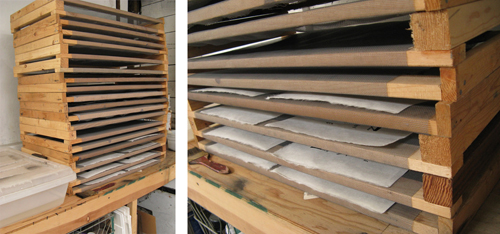
Barry came up with a ridiculously clever, incredibly simple, drying rack solution. He made some simple rectangular wood “frames,” each covered with window-screen mesh. These can be stacked up to about twenty high. The wood strips create a gap between each layer, so nothing touches the face of each print, and the mesh allows air to circulate.


Clever drying racks made from cheap, available materials

I definitely value having an art space where I can get a bit messy, and where I can leave works-in-progress sitting out, ready to be resumed at a moment's notice. This is less practical when one's only working space is in one's bedroom. (I have been in that situation before, a small bedroom at that. It is no coincidence that I made very small-scale works at that time. Also, I made use of clotheslines stretched across the bedroom as drying racks. Then, as now, I was using oil-based printing inks, which take quite a while to dry.)


Ink ready to roll out

Would you say your personal style runs more towards clutter or organization? Does your style work for you, or are there elements of it you wish you could change?

I tend to accumulate things. I continually struggle with shifting my disorganized piles of things into “more organized” piles. “Organized clutter” appears to be my norm. A non-cluttered environment does not seem to be an option for me! A clean, Zen-like space with lots of empty surfaces sounds lovely but unattainable... but it could be that a cluttered environment stimulates my creativity in some secret way.


Lexi's workspace with image being transferred to a wood block

Do you ever have to choose between doing some aspect of your work "the lazy way" versus "the better but far more annoying way," and has going for "the lazy way" ever produced unexpectedly awesome results?

This may sound perverse, but I tend to work in the most labor-intensive methods available to me! However, this is because I enjoy those labor-intensive methods. I create meticulously detailed, hand-drawn, hand-carved, hand-printed woodcuts, frequently multicolored, in a method that requires that a separate block be carved for each color. Not only that, but most artists, when faced with depicting a brick wall, will try to suggest bricks without drawing every single one. Trying to draw every brick is a crazy maneuver, generally only attempted by particularly driven and obsessive self-taught artists. I like to carve out every brick in a brick wall.


Every brick carved by hand

There is a rhythm to carving them out, “brick, brick, brick,” similar to the “stitch, stitch, stitch,” of knitting a scarf. (I am talking about bricks here, but the same is true of other repetitive patterns I may incorporate into a piece.) Ultimately, this seems to create a buzzing vibration across the surface of the image.


“MJB Coffee WHY?” woodcut by Alexis Babayan

I will say, however, that the fact that I need to carve a separate block for each color leads me to think whether every color in the image is strictly necessary... For instance, can I use just two colors and make it “feel” like a full spectrum? Can I declare, for the purpose of one image, that “green” is actually the same thing as “black?” A limited palette can help to create very strong, energetic-feeling images. This is where the physical difficulty of making the image helps me to pare it down to the essentials.


“Easy Liquor/ Best Fire” woodcut by Alexis Babayan

Are there any particular patterns or motifs that creep into your work when you're not paying attention, and have you given any thought to where they might come from?

I seem to be very partial to the color of rust, and I take particular pleasure in knowing that the pigment in my rust-colored ink is a form of iron oxide and hence chemically the same as rust! That color is particularly beautiful against a vibrant blue or turquoise, and I tend to seek out scenes that include those ingredients. I like certain repeating patterns, like brick walls and chain link fences. I also like things that break up patterns, like weeds growing through cracks in the concrete. When I am drawing absentmindedly while thinking of something else, I nearly always draw human forms and faces. My “serious” art, these days, rarely includes human figures. However, it nearly always includes indirect signs of human presence.


“Read a Book” Woodcut by Alexis Babayan

 Are you a stickler about your particular medium, or are you happy to cheat, borrow and steal from other disciplines whenever it seems like a good idea?

I am a stickler about “making things by hand” but I am not so much of a stickler when it comes to what particular raw materials I use. Sometimes I carve into wood, sometimes I carve into linoleum. Both are “relief printmaking” and I consider them to be basically the same thing, though the different materials have different strengths and weaknesses. The major difference is texture: linoleum has no grain. This can be helpful in images with lots of tightly curving lines. (Wood has a strong opinion about how it wants to be carved, and objects to curlicues that go against the grain!) However wood generally “feels” nicer to carve, and the wood grain often creates happy accidents that couldn't happen any other way. Sometimes I will use both wood and linoleum for different layers of a multi-block print.


“Union Machine Works” Woodcut and linocut by Alexis Babayan

Have you ever spent Way Too Much on some exciting new art-making tool and it ended up being the best idea ever? (tell us the story!) Alternately, have you ever done the same thing and it did NOT work out at all? (give us all the gory details!)

I spent a lot of money on a really nice large brayer, imported from Japan. Later on I bought a small one of the same type. (Like these: http://www.imcclains.com/catalog/brayers/japanese60durometer.html They are even more expensive now than they were then, but eventually I want to acquire another one!) It was worth it to me. The thing is, the inexpensive soft rubber brayers you get from Speedball work quite nicely for most purposes. (Those are the ones you can find in just about any art store.) Speedball also makes a hard rubber brayer, which is almost completely useless—it will slide around on the ink rather than picking it up evenly. These brayers are firmer than Speedball's soft brayer but softer than Speedball's hard brayer. Because they are on the firm side, they discourage over-inking. They are exactly the right texture for emphasizing wood grain and retaining fine detail. The larger width and diameter help to apply the ink evenly. If you see my working set-up, you will find that I often have three or four brayers in use simultaneously with different colors of ink. I've got the two Japanese brayers and an assortment of Speedball soft rubber brayers.

One time, I ordered a “nice” chisel from Daniel Smith that cost twenty-some dollars. (I had a gift certificate that was burning a hole in my pocket.) It is nice and sharp and the blade is a good shape, but the handle just doesn't feel comfortable in my hand so I almost never use it. I greatly prefer my Power Grip tools, which cost about eight bucks apiece.

The least expensive art tool which I use regularly (and which I love,) is a bamboo rice paddle which I bought from a Chinese grocery store for about one dollar. I use it as a baren (burnishing tool for hand printing.) I like it better than “official” barens that I have tried. I even prefer it to a multi-thousand dollar printing press!


The rice paddle magically brings the print to life!

Are you currently having a passionate love affair with a particular medium or technique or concept, and would you care to share all the steamy details?

I am passionately in love with both my medium (woodcut printmaking) and my subject matter (urban street scenes and signage.) We have been together long enough that we should really be considered to be married under common law!

Describe your sketchbook (or other Vital Idea Capturing Aparatus). Do you work in such a way that there is a great distance between sketches and finished projects, or are you more likely to incorporate your sketches directly into your final work?

I use a camera for the initial stage of image-gathering. My current body of artwork would not exist were it not for my habit of taking long walks accompanied by a camera. Sometimes I use a heavy old 35mm film camera that used to belong to my grandfather. I like the ritual of using it. Other times I use a digital camera, for expediency. The photos do not become part of the final piece, they are part of my own personal documentary project. Later on I make drawings based upon some of the photographs. Usually those drawings are not in a sketchbook, but on various stray pieces of paper. I change up my drawing methods: sometimes I work out my drawing in brush and ink, other times regular graphite pencil, other times white pencil on black paper, or whatever drawing tool feels right at the time. I choose which elements to emphasize and how to translate the image into the printmaking medium. Often I end up re-drawing my image on trace paper, for ease in transferring the image to a woodblock. As I carve the image into the block, there are still things that need to be edited and decisions that need to be made. The process is still “alive.” I am not just duplicating my earlier sketch. I keep my photograph nearby as I am carving the block. I also use a small mirror as an extremely useful “wireless graphics tool” (marvelous for reversing images.)


Carving tools and mirror

Do you ever find yourself anthropomorphizing the media you work with or a particular aspect of your process?

Yes. I work with a lot of very sharp tools, and I have a theory that if I treat them with respect they will serve me well and won't cut me. If I ever disrespect them, or act blasé about their abilities, they will probably turn upon me and cut me. In general, my tools and I have a very good working relationship.

What is the best thing about people bringing their own unique interpretations when they interact with your work? Also, have you ever heard someone's interpretation of something you made and thought to yourself, "Gee, I'm not sure where you got that one, but I wish you'd toss it back where it came from!"?

I work with some very specific local landmarks in my art, so that provides an entry point to conversation that wouldn't be there if my work was more abstract. Someone who grew up in the neighborhood can talk about their memories and feelings about a certain place, about local history, and about scandals that happened a long time ago! However, it irks me when someone just tells me that my work is “funny.” It has an element of humor, but that is mixed in with other elements, such as finding genuine beauty and pathos in unexpected places.


“Lite House” Woodcut by Alexis Babayan

Sunday, April 7, 2013

Artist Interview with Nancy Crasco

This week's featured artist is Nancy Crasco, a fiber artist with a ridiculously extensive history of exhibitions and teaching experience. I discovered Ms. Crasco's work while I was Googling all of the artists with whom I will be participating in SAQA's exhibition, "Deux," later this year, and I immediately fell in love with her work for its elegance, graceful color choices and excellent craftsmanship.

Are there any particular patterns or motifs that creep into your work when you're not paying attention (as opposed to the motifs you've consciously chosen to work with), and have you given any thought to where they might come from?
Many  of my early works were inspired by the direct observation and interpretation of nature and landscape, but I gradually progressed to a more critical point of view during the 1990's with a series of "soft protests"; visual commentaries on air and water pollution.  My current series of larger works pinpoints what is happening in the oceans and other bodies of water as a result of climate change.

I keep returning to watery themes.  I grew up in New Jersey and experienced the ocean, lakes and rivers from an early age.  Swimming is my favorite exercise and I frequent the neighborhood YMCA, where I swim two or three times a week. I still love the beach and other coastal areas, particularly salt marshes and estuaries, and enjoy drawing at these sites.

Water flows in my works, both consciously, as in the the ocean series or unbidden, like "Salt Marsh Spring" (2006) in a series about the seasons, or "Sailing off the Grid" (2009) in a series of twelve works entitled "Off the Grid."  "Swimming Against the Tide" is part of an ongoing series that interprets climate/weather adages.  Both pieces in DEUX are part of that series.

"Sailing Off the Grid," by Nancy Crasco


Are you a stickler about your particular medium, or are you happy to cheat, borrow and steal from other disciplines whenever it seems like a good idea?
I often use newspaper articles and photographs for inspiration.  When I need an image of a specific organism, animal or plant for my work, I research and use photos from the Internet for reference, but I am very careful not to violate any copyright laws. For example, in my recent piece "Diatoms"' I needed to know what diatoms actually looked like.  So I did some research on the Internet and found that I could represent them by using a collection of old doilies, and printed with them on mulberry paper.  Then I arranged  and sewed them between layers of silk.  I print images on paper or silk using a gelatin plate, and also use linoleum prints in my work.

"Diatoms," by Nancy Crasco
I have a degree in art from the Rhode Island School  of Design, and visit art museums and galleries and attend other art events quite regularly.  I sometimes see something in the works of other artists that generates an idea. I occasionally take classes, and have attended summer sessions at The Haystack Mountain School of Crafts in Deer Isle, ME.  Several of these sessions have added techniques to my craft vocabulary, and have had a significimpact on my work.

I do not believe that artists create in a vacuum sealed environment.  They are affected by all that happens around them and it is how they process this sensory information that results in artistic products, which are new ways of looking and describing what they know and feel.

Describe your sketchbook (or other Vital Idea Capturing Apparatus). Do you work in such a way that there is a great distance between sketches and finished projects, or are you more likely to incorporate your sketches directly into your final work?
I maintain several types of sketchbooks.  I try to carry a small one when I visit art venues as I often like to sketch or note something I have seen to research in more detail later: the name of an artist, a technique with which I am unfamiliar, or a quote or a construction detail I want to remember.  I have a second collection of drawing sketchbooks that I have filled with land and cityscapes when I travel or vacation.  The third type of sketchbook I keep is a record of visual references and thought processes for most of my works.  I also keep a running log of work hours, expenses and income.

Pages from Nancy's working sketchbook. These were sketches for her piece "Tip of the Iceberg" which is shown below.
Are there people in your life who always come through with excellent input that continually helps you improve your work?  What is it that these people see that makes them so helpful?
I am very fortunate to belong to a critique group of seven fiber artists which meets monthly to share current work or work in progress with an open exchange of ideas and constructive criticism.  We all work in fiber but have very different voices. We have been meeting for more than twenty years and can be very honest and open with each other about our work without the risk of personal affront.  We listen to each other as critiques are rendered, but we feel no obligation to carry out what is suggested.  The suggestions sometimes lead the artist to another, satisfactory solution altogether.

I also have a best friend that I have known since we were students at RISD together, and we talk to each other frequently and more recently this includes showing each other our work using FaceTime on our iPads.  Another RISD classmate lives close by and is a printmaker.  We attend a lot of art exhibits and museums together, and share our works in progress as well.

Nancy's sketches of Batiquitos Lagoon
"Salt Marsh Spring," by Nancy Crasco

You live in Massachusetts - what opportunities exist locally for fiber artists?  What about the character of your city do you find particularly inspirational? Are there any local organizations or groups you'd like to mention so they can get more exposure?
Boston is a great city for art and is very welcoming to fiber artists.  Most of the local arts organizations like The Cambridge Art Association and Arsenal Center for the Arts in Watertown, accept fiber entries in their shows equally with the "fine arts", and  the myriad of quilt guilds in the Greater Boston Area guarantees that there are quilt exhibits year round.  We have the New England Quilt Museum and the American Textile Museum, both just 45 minutes away in Lowell.  Boston and many other towns and cities in the area have local art centers with galleries, studios for artists and thriving educational programs.  In the fall and again in the spring there are many Open Studio events which gives one the opportunity to visit with many different artists and to purchase work directly from the artists.  Boston is home to too many great museums to single out, and they all show fiber, but the Fuller Craft Museum in Brockton and the Peabody Essex Museum in Salem are especially good.

"Tip of the Iceberg," by Nancy Crasco

Do you have any extremely talented artist friends whose work you'd like to plug here on the blog?  They don't have to be fiber artists, just super cool folks who could use a little blog love.
The co friends that I mentioned in your earlier question are:
Judy Becker
Linda Behar
Elizabeth Busch
Sandy Donabed
Sylvia Einstein
Carol Anne Grotrian
Jude Larzelere
Adrienne Sloane
Patricia White

"Swimming Against the Tide," by Nancy Crasco

Thanks so much to Nancy Crasco for an excellent interview - I cannot believe the number of wonderful sounding museums that will await me when I finally arrange a trip up to the Boston area.  This is at least a week's worth of entertainment in a single paragraph! Also, I feel truly inspired by the idea of developing such close artistic friendships over the course of more than twenty years - that's a wonderful goal for an artist!

Thursday, March 28, 2013

Artist Interview with Kit Vincent, Part 2

Hello all, and welcome to the second half of my interview with quilt artist Kit Vincent! You can read the first half here, in which Kit shares gorgeous views of her studio and describes how she works and the materials she uses.  Now, on to some questions about her artistic process and where she goes for imspiration!

Are you currently having a passionate love affair with a particular medium or technique or concept, and would you care to share all the steamy details?
For me, fabric is a sensual and easily manipulated ground. It can be made to have weight, mass and texture. It is less constraining than stretched canvas. It can be dyed, painted, folded, cut, stitched and embroidered at will. I see this fabric less as cloth and more as un-primed, un-stretched ground. The processes that I use allow me to build in texture and layered meaning into my work.
I am also drawn to the liveliness of the stitch when working with textiles. The stitch is an entirely different mark-making tool than a pencil or brush. I don't aim for perfect form when stitching or a perfect length of stitches - either by hand or machine. I want my stitches to speak, to add texture, and to sparkle if necessary. I want my stitching to be individual, a personal expression and not regulated in any way, not dissimilar from a drawing.
The other aspect I love about stitching is the ability to create texture. Texture adds interest to the surface and is something that other materials do not accomplish to the same extent. I can make the texture even; make it with slight variations; or create variegated textured surfaces. The unstitched spaces are as interesting as the stitched areas. I can also create line with stitch, an important element of design. Then there is thread colour; I can make that line speak even more within the work. I think of stitching as an endless opportunity to create impact.  

Wild I, 51x45”, hand-dyed, discharged silks and cottons, fabric collage, machine quilted and embroidered

Describe your sketchbook (or other Vital Idea Capturing Apparatus). Do you work in such a way that there is a great distance between sketches and finished projects, or are you more likely to incorporate your sketches directly into your final work? 
I have several sketchbooks on the go at any one time (almost one in every room – even the car).  I also dabble with acrylic painting and collage.  However, when designing with fabric on the wall, I tend not to use my original ink sketches or acrylic collages as templates for these larger pieces. Instead they serve as departure points. As I progress, I become obsessed with every coloured shape of dyed cloth and how it looks next to its neighbour. I am also careful when sewing a flat, sometimes curved seam, which unites these shapes and introduces an added line to the overall composition. The original sketch may sit close by for a while, but I will progressively move away from it, as I build up this larger work.
Once assembled, I then introduce additional line-work and texture to this new surface using free-motion machine embroidery. At that point, I will sometimes return to my original sketch for hints as to texture and other insights that propelled the composition in the first place. This process allows me to build up these compositions in a personal way. I want the techniques I use to enhance my subject.

Examples of sketchbooks with ink studies

Are there people in your life who always come through with excellent input that continually helps you improve your work?  What is it that these people see that makes them so helpful?
In 2001, I came across the work of Nancy Crow. As I looked at her large bold fabric compositions I realized that sewing and quilting could be fine art. I was hooked! This was the kind of work I wanted to do. I pulled an old sewing machine out of a cupboard and began to teach myself how to sew.
Nancy Crow pioneered moving the quilt from a traditional craft into an evolving art form, in particular improvisation and freehand cutting. I love her creative spirit and artistic insight. I have since endeavoured to learn as much from her as I can. Below is a snippet from her artist statement. I include it here as I find it is so powerful:
"When I work on a quilt, I put away all thoughts that are not helpful and channel my energies towards relaxing and becoming one with my fabrics. Since I work intuitively, this is absolutely important. I begin to see shapes in my head and think about how to cut them out of my huge palette of colors that I have hand-dyed in my basement dye studio. I love being inside my brain and pushing myself to think in ever more complex ways because I know the ideas are there for the taking. It's all about being focused and disciplined and making use of one's abilities. And about being alone, in solitude, so one can think and feel deeply without interruption. I have definitely grown far closer to myself rather than to others because I see my quilt making as my experience which has nothing to do with other people."

Do you have any concrete advice about how to do away with artist's block?
When I need a quick creative fix, I will sketch with whatever is available.  For me, drawing helps me understand what surrounds me.  I get to slow down and look hard at some object as I attempt to sketch it and work in into a composition.  I keep several notebooks going, in almost every room of my house.  Pen and ink are favourites with acrylic paints and collage (both fabric & paper) as runners up.
When sketching, I see myself as being on a hunt - searching for shapes, patterns and objects that move me. I may focus on sketching shadows, shades, water movement, weather and music. Several small studies serve as inspiration for larger stitched work. I have also taken up hand stitching as a form of sketching, small studies can be done quickly -  postcard size (4x6") or less.  Working with fabric can be expensive and time consuming as an art form. These small studies help to keep my work consistent and focused.

ink and paper collage

Would you say that there is some particular thing that you are channelling while you work? How would you describe that something?
Anything is game for me when it comes to working with colour and composition. It may begin with a news event, a trip, the river that I live on, or the transport rigs that I routinely drive next to on the 401 Highway near my home. Any of these have been major sources of creative energy in the past; however, they are only departure points. They change and evolve as I work, often causing me great anxiety in the process. My objective is to produce stitched art that is motivated by metaphors for energy and movement. The subjects that I wish to address are universal and can suggest imagery evocative of nature, such as water, flowers, seeds and on occasion, vegetables.


Example of how a small thumbnail sketch (inset at top right) led to a large quilt top.  This piece (working title: Big Red) measures roughly 36 x 48 and is not yet quilted.

Are there any colors that give you particular trouble?  
Colour is a passion of mine.  I collect paint chips of all kind - have a big bin; and love sorting them into several combos.  That is how I learn how colours will behave with each other.  

paint on paper - complementary colour studies

Is there a piece you'll (probably) never sell? What is it, and why is it going to be staying with you?
Yes, a whole-cloth quilt I made back in 2005, on the return from a trip to France to commemorate the 60th anniversary of  D Day.  This quilt is about the brutal and shattering effects of war.  My uncle was 22 and the bombardier on an RAF Lancaster when it was shot down over northern France in July 1944.  The pilot struggled to miss the town of Marcilly and the plane crashed into a nearby beat field with the loss of all aboard.  Witnesses said it burned for 24 hours.  The farmer who owns the field told me that even today, he still ploughs up fuselage and armaments from the site.
For the imagery I air-brushed fabric paint onto a canvas that had been previously painted with an acrylic and pastel base.  I made three whole-cloth pieces in rapid succession and submitted them to Quilt National that September.  This piece was accepted. 


Lancaster Series:  Witness 54x59" whole cloth, painted, airbrushed, dry pastel, machine embroidered and quilted


Do you ever find yourself anthropomorphizing the media you work with or a particular aspect of your process?
Wow – that is a big word!  I had to look it up.  Do I attribute 'human qualities' to  the media I use?  Such as my sewing machines, my dyed fabric and thread stashes?  You bet.  They are my BFFs!

You live in Elizabethtown, Ontario. What opportunities exist locally for fiber artists? 
We have a very active Regional SAQA group here who meet regularly to organize shows and learning events.  I am in awe with the generosity and sustained hard work of these  SAQA organizers.  This benefits us all as there is so little else in this region!

Recent fabric collage workshop I delivered in Kingston, Ontario

Do you have any extremely talented artist friends whose work you'd like to plug here on the blog?  They don't have to be fiber artists, just super cool folks who could use a little blog love. 
I would simply like to direct you to our regional SAQA Central blog: http://saqacentralcanada.blogspot.ca/ 
You will find an active list of very talented local art quilt members to the right of the HOME page.
  
Have you ever made a piece that ended up being so unsuccessful that there was no way to salvage it? What do you think happened, and what ended up being that piece's eventual fate?
I keep a healthy stack of ‘less than spectacular’ pieced and stitched efforts under my cutting table.  Some of these are now beds for Lola, my husky and beloved studio companion.  But, more often, I have turned these upside down, cropped and incorporated them into some very interesting new mixed-media collages.  Lessons learned?  I no longer throw these out or burn them – they are kept for future fabric adventures…when the time is right.

Swept Up, 41x31", 2006, hand-dyed silks, fabric collage, machine quilted

Swept Up, detail

Thank you so much, Kit Vincent, for answering my questions so well! I hope everyone enjoyed the interview - I was particularly thrilled to see so many sketchbook images and process photos. Nothing enhances my experience of other artists' work more than seeing all the lovely behind-the-scenes moments that go into its creation!