Monday, April 15, 2013

Art Show: "Pleased to Meet You" at Materials For The Arts

For the past several months I have been having a glorious time volunteering a couple of days a week at Materials For The Arts, my absolutely favorite arts-based nonprofit organization in New York.

I had known about these guys for several years but had never been there until I started volunteering.  MFTA is seriously like some sort of magical wonderland in which nothing that could be used to create art ever has to become garbage ever again.  Also, deserving and underfunded arts groups and schools can have access to all the materials they need to enrich the lives of New Yorkers.  I freaking love this whole concept, and all the dedicated people at MFTA do every part of the process so well!  Have I been drinking the Kool-Aid? YOU BET.

Anyway, Materials For The Arts is having their staff show, "Pleased to Meet You," right now and they offered to let me put in a few pieces!  I attended the show's opening night this past Thursday, and it was a wonderful evening, with fun conversation, tasty cheeses, excellent artwork and not a single moment of pretentious or boring conversation. How many experiences contain all those things?

I took some photos at the event, so please enjoy these images of some of the pieces in the show (though by no means all of them!).  Then go check out MFTA's website and blog!

If you live in the New York area and you have some sort of art supply you'd like to go to a good cause, definitely get in touch with them - no donation is too small, and even the weirdest stuff is guaranteed to end up exactly where it needs to be! 

And now, some ART!

PTMY Crochet Environment by Olek
When you first arrive at MFTA you know you're already in a different world (Art Work = "Crochet Environment" by Olek)

PTMY hallway entrance
The fabulously industrial hallway space where the show is installed - look, there are my pieces right at the beginning!

PTMY House by Dan Darbandi
"House" by Dan Darbandi

PTMY Green Orbit by Jenny Kraft and Green Being by Chase Carlisle
"Green Orbit" by Jenny Kraft and "Green Being" by Chase Carlisle

PTMY Installation Recopilacion II by Luisa Tamara
"Installation Recopilacion II" by Luisa Tamara

PTMY Bird is Visiting by Sabu
"Bird is Visiting" by Sabu

PTMY Art Darts by John Cloud Kaiser of Freeystyle Family
"Art Darts" by John Cloud Kaiser of Freeystyle Family

PTMY For Steppenwolf by Marna Chester
"For Steppenwolf" by Marna Chester (rotating sculpture, exterior and interior views shown)

PTMY Chair by Joel Frank
"Chair" by Joel Frank

PTMY Magic Forest by Doris Littlejohn
"Magic Forest" by Doris Littlejohn

PTMY two untitled pieces by Ben Pederson
Two untitled pieces by current MFTA Artist in Residence Ben Pederson

Friday, April 12, 2013

Art Show, "Paths: Sculpture & Watercolor by Kathy Creutzburg," at Michael Mut Gallery

I often end up going to exciting art events because someone I know is acquainted with an artist. In this case, it turns out my boyfriend is friends with a woman who embodies one of the exciting New York City Artist tropes - Kathy Creutzburg is a painter, sculptor and mixed media artist who lives in the East Village and makes things from other things that she has found.

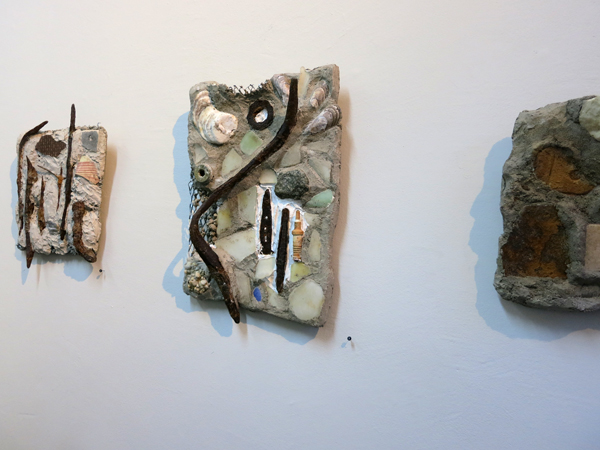
Kathy's show, at Michael Mut Gallery on Avenue C, consists of both two dimensional and sculptural work. I was most drawn to her paintings and wall-mounted mosaics so those are the pieces I'm featuring here.

The show includes subtle, thoughtful touches that I noticed and appreciated.  First, Kathy's work is perfectly sized to fit attractively into the space available (Michael Mut Gallery is a teeny, intimate space which really gives smaller artwork the opportunity to shine as it should). Kathy worked with a curator for her show, Marie Katherine Vigneau, who provided help around which works were selected and how the space was used. The second thing I noticed is a small thing, but it made me really happy - the gallery uses those little thumb tacks with embossed numbers on them to indicate how to find a work on the price list.  Adorable and classy!

Michael Mut Gallery's website has this to say about the show:

"Paths is a collection based on an artist's journey. Her materials and ideas are collected remnants found along different paths. Some of these paths are taken alone, while others are shared. As we move forward, trails both tangible and invisible are left behind. The East River, becomes a metaphor for process, meandering in one direction and then another. .... The watercolors illustrate the journey whereas the sculptures embody the outcome of the voyage."

My favorite works in this show were the pieces that most directly reflected the title.  These are small scale watercolor paintings which contain literal map-like elements. Seeing these little imagined map paintings made me realize that there are a lot of fiber artists whose work is based on making maps, like Emily Miah Stewart, Linda Gass, Valerie Goodwin, and sometimes me! My theory about why this theme emerges so often for fiber artists is that we are very concerned with seeking meaningful ways of filling space, since we have to actively construct every part of our work. 

I wrote a few questions for Kathy based on my thoughts about her show, and she very kindly carved out some time to give excellent answers to them.  Read her responses below, then go see her work:

"Paths," through April 27, 2013  
Michael Mut Gallery 
97 Avenue C at 6th St 


Larger paintings featuring stenciled designs

Could you give some thoughts about what it was like to work your curator?  How did she help to clarify the show's message? What was the selection process like for determining which pieces ended up in the show (joyful, painful, somewhere in between)?

I came across Michael Mutt's gallery a couple of years ago. He is an artist, and I participated in one of his projects. I live right around the corner from the gallery, on 7th Street between B and C. More recently, I asked Michael to look at my artwork at my studio- which is in the back, behind my apartment. He came over, and he offered me a solo show. I was kind of surprised (and ecstatic!) because I had never had one. Marie Vigneau works with Michael, and was my curator, and she was very thoughtful about her choices of which pieces to put in the show. We had the freedom to find the direction that the show would go. After looking over the watercolors and  sculptures on several occasions, particular groups of work began to blend together. I have been working on the idea of paths for a number of years, and the idea seemed to bridge my public art projects with my personal work. We began with the show title Paths That Lead There, which was edited to Paths. I really appreciate feedback from the people I work with because it allows me to think of my artwork in a new way. The edited title addresses the work that we were choosing, as well as opening up new possibilities for future work.

Kathy's work has a fantastic sense of something happening just beyond what we can actually see.

(continued...) In the past, I have collaborated with other artists, a writer, students, teachers, family members, etc., so working with others is part of what I do. My feeling is that more than one mind just adds dimension to artwork. Since Marie and I were both new, we did not begin with pre-conceived ideas about how to create an exhibit. I felt like I had taken my time to find my direction as an artist (which is the hardest part!), and the process had run its course. Marie was then able to think about which pieces fit together aesthetically, and how to place them to make them the most effective. She was also reconciling the connection between the watercolors and sculptures, how paintings of the maps and the sculptures were related. Michael also offered some guidance, as well as my son, Klay. Movement paths connect with so much of what I am doing in so many different ways. There is both a physical and a psychological dimension to the idea. It affects my daily life.

Four small scale map-themed watercolor paintings

You clearly made some very thoughtful choices about how to price your work, and I am curious about how you arrived at your price structure.  As both a fellow artist and a very non-wealthy New Yorker I was greatly impressed by your decision to include incredibly affordable pieces in your show, allowing normal people to own original artwork.

I priced the artwork to be accessible to my present audience, and because I, too, love to purchase art and I lack the budget to do it. I think back to what was affordable to people who have bought from me in the past, and what I have made on commissioned pieces. I really want to put my artwork out for people to enjoy, and the best way to do that is to make it affordable.

Mosaic style pieces made from found objects collected along the East River

Since I normally write about fiber art, I would love to hear whether you have ever made any pieces using fiber techniques such as quilting, weaving, felting, embroidery and dyeing.

I have studied weaving, and when I was a student, I designed and built my own counterbalance floor loom. I was really fascinated with building a machine, and figuring out how the parts work together. I still have my loom, but it is not set up (mostly due to space issues). I also sew and do needlepoint, when a project calls for something like that. At any rate, I find myself bending and twisting things such as wires, steel rod and recycled materials in such a manner that echoes the soothing rhythm of fiber art processes.

The postcard for Cathy's show

Sunday, April 7, 2013

Artist Interview with Nancy Crasco

This week's featured artist is Nancy Crasco, a fiber artist with a ridiculously extensive history of exhibitions and teaching experience. I discovered Ms. Crasco's work while I was Googling all of the artists with whom I will be participating in SAQA's exhibition, "Deux," later this year, and I immediately fell in love with her work for its elegance, graceful color choices and excellent craftsmanship.

Are there any particular patterns or motifs that creep into your work when you're not paying attention (as opposed to the motifs you've consciously chosen to work with), and have you given any thought to where they might come from?
Many  of my early works were inspired by the direct observation and interpretation of nature and landscape, but I gradually progressed to a more critical point of view during the 1990's with a series of "soft protests"; visual commentaries on air and water pollution.  My current series of larger works pinpoints what is happening in the oceans and other bodies of water as a result of climate change.

I keep returning to watery themes.  I grew up in New Jersey and experienced the ocean, lakes and rivers from an early age.  Swimming is my favorite exercise and I frequent the neighborhood YMCA, where I swim two or three times a week. I still love the beach and other coastal areas, particularly salt marshes and estuaries, and enjoy drawing at these sites.

Water flows in my works, both consciously, as in the the ocean series or unbidden, like "Salt Marsh Spring" (2006) in a series about the seasons, or "Sailing off the Grid" (2009) in a series of twelve works entitled "Off the Grid."  "Swimming Against the Tide" is part of an ongoing series that interprets climate/weather adages.  Both pieces in DEUX are part of that series.

"Sailing Off the Grid," by Nancy Crasco


Are you a stickler about your particular medium, or are you happy to cheat, borrow and steal from other disciplines whenever it seems like a good idea?
I often use newspaper articles and photographs for inspiration.  When I need an image of a specific organism, animal or plant for my work, I research and use photos from the Internet for reference, but I am very careful not to violate any copyright laws. For example, in my recent piece "Diatoms"' I needed to know what diatoms actually looked like.  So I did some research on the Internet and found that I could represent them by using a collection of old doilies, and printed with them on mulberry paper.  Then I arranged  and sewed them between layers of silk.  I print images on paper or silk using a gelatin plate, and also use linoleum prints in my work.

"Diatoms," by Nancy Crasco
I have a degree in art from the Rhode Island School  of Design, and visit art museums and galleries and attend other art events quite regularly.  I sometimes see something in the works of other artists that generates an idea. I occasionally take classes, and have attended summer sessions at The Haystack Mountain School of Crafts in Deer Isle, ME.  Several of these sessions have added techniques to my craft vocabulary, and have had a significimpact on my work.

I do not believe that artists create in a vacuum sealed environment.  They are affected by all that happens around them and it is how they process this sensory information that results in artistic products, which are new ways of looking and describing what they know and feel.

Describe your sketchbook (or other Vital Idea Capturing Apparatus). Do you work in such a way that there is a great distance between sketches and finished projects, or are you more likely to incorporate your sketches directly into your final work?
I maintain several types of sketchbooks.  I try to carry a small one when I visit art venues as I often like to sketch or note something I have seen to research in more detail later: the name of an artist, a technique with which I am unfamiliar, or a quote or a construction detail I want to remember.  I have a second collection of drawing sketchbooks that I have filled with land and cityscapes when I travel or vacation.  The third type of sketchbook I keep is a record of visual references and thought processes for most of my works.  I also keep a running log of work hours, expenses and income.

Pages from Nancy's working sketchbook. These were sketches for her piece "Tip of the Iceberg" which is shown below.
Are there people in your life who always come through with excellent input that continually helps you improve your work?  What is it that these people see that makes them so helpful?
I am very fortunate to belong to a critique group of seven fiber artists which meets monthly to share current work or work in progress with an open exchange of ideas and constructive criticism.  We all work in fiber but have very different voices. We have been meeting for more than twenty years and can be very honest and open with each other about our work without the risk of personal affront.  We listen to each other as critiques are rendered, but we feel no obligation to carry out what is suggested.  The suggestions sometimes lead the artist to another, satisfactory solution altogether.

I also have a best friend that I have known since we were students at RISD together, and we talk to each other frequently and more recently this includes showing each other our work using FaceTime on our iPads.  Another RISD classmate lives close by and is a printmaker.  We attend a lot of art exhibits and museums together, and share our works in progress as well.

Nancy's sketches of Batiquitos Lagoon
"Salt Marsh Spring," by Nancy Crasco

You live in Massachusetts - what opportunities exist locally for fiber artists?  What about the character of your city do you find particularly inspirational? Are there any local organizations or groups you'd like to mention so they can get more exposure?
Boston is a great city for art and is very welcoming to fiber artists.  Most of the local arts organizations like The Cambridge Art Association and Arsenal Center for the Arts in Watertown, accept fiber entries in their shows equally with the "fine arts", and  the myriad of quilt guilds in the Greater Boston Area guarantees that there are quilt exhibits year round.  We have the New England Quilt Museum and the American Textile Museum, both just 45 minutes away in Lowell.  Boston and many other towns and cities in the area have local art centers with galleries, studios for artists and thriving educational programs.  In the fall and again in the spring there are many Open Studio events which gives one the opportunity to visit with many different artists and to purchase work directly from the artists.  Boston is home to too many great museums to single out, and they all show fiber, but the Fuller Craft Museum in Brockton and the Peabody Essex Museum in Salem are especially good.

"Tip of the Iceberg," by Nancy Crasco

Do you have any extremely talented artist friends whose work you'd like to plug here on the blog?  They don't have to be fiber artists, just super cool folks who could use a little blog love.
The co friends that I mentioned in your earlier question are:
Judy Becker
Linda Behar
Elizabeth Busch
Sandy Donabed
Sylvia Einstein
Carol Anne Grotrian
Jude Larzelere
Adrienne Sloane
Patricia White

"Swimming Against the Tide," by Nancy Crasco

Thanks so much to Nancy Crasco for an excellent interview - I cannot believe the number of wonderful sounding museums that will await me when I finally arrange a trip up to the Boston area.  This is at least a week's worth of entertainment in a single paragraph! Also, I feel truly inspired by the idea of developing such close artistic friendships over the course of more than twenty years - that's a wonderful goal for an artist!

Thursday, March 28, 2013

Artist Interview with Kit Vincent, Part 2

Hello all, and welcome to the second half of my interview with quilt artist Kit Vincent! You can read the first half here, in which Kit shares gorgeous views of her studio and describes how she works and the materials she uses.  Now, on to some questions about her artistic process and where she goes for imspiration!

Are you currently having a passionate love affair with a particular medium or technique or concept, and would you care to share all the steamy details?
For me, fabric is a sensual and easily manipulated ground. It can be made to have weight, mass and texture. It is less constraining than stretched canvas. It can be dyed, painted, folded, cut, stitched and embroidered at will. I see this fabric less as cloth and more as un-primed, un-stretched ground. The processes that I use allow me to build in texture and layered meaning into my work.
I am also drawn to the liveliness of the stitch when working with textiles. The stitch is an entirely different mark-making tool than a pencil or brush. I don't aim for perfect form when stitching or a perfect length of stitches - either by hand or machine. I want my stitches to speak, to add texture, and to sparkle if necessary. I want my stitching to be individual, a personal expression and not regulated in any way, not dissimilar from a drawing.
The other aspect I love about stitching is the ability to create texture. Texture adds interest to the surface and is something that other materials do not accomplish to the same extent. I can make the texture even; make it with slight variations; or create variegated textured surfaces. The unstitched spaces are as interesting as the stitched areas. I can also create line with stitch, an important element of design. Then there is thread colour; I can make that line speak even more within the work. I think of stitching as an endless opportunity to create impact.  

Wild I, 51x45”, hand-dyed, discharged silks and cottons, fabric collage, machine quilted and embroidered

Describe your sketchbook (or other Vital Idea Capturing Apparatus). Do you work in such a way that there is a great distance between sketches and finished projects, or are you more likely to incorporate your sketches directly into your final work? 
I have several sketchbooks on the go at any one time (almost one in every room – even the car).  I also dabble with acrylic painting and collage.  However, when designing with fabric on the wall, I tend not to use my original ink sketches or acrylic collages as templates for these larger pieces. Instead they serve as departure points. As I progress, I become obsessed with every coloured shape of dyed cloth and how it looks next to its neighbour. I am also careful when sewing a flat, sometimes curved seam, which unites these shapes and introduces an added line to the overall composition. The original sketch may sit close by for a while, but I will progressively move away from it, as I build up this larger work.
Once assembled, I then introduce additional line-work and texture to this new surface using free-motion machine embroidery. At that point, I will sometimes return to my original sketch for hints as to texture and other insights that propelled the composition in the first place. This process allows me to build up these compositions in a personal way. I want the techniques I use to enhance my subject.

Examples of sketchbooks with ink studies

Are there people in your life who always come through with excellent input that continually helps you improve your work?  What is it that these people see that makes them so helpful?
In 2001, I came across the work of Nancy Crow. As I looked at her large bold fabric compositions I realized that sewing and quilting could be fine art. I was hooked! This was the kind of work I wanted to do. I pulled an old sewing machine out of a cupboard and began to teach myself how to sew.
Nancy Crow pioneered moving the quilt from a traditional craft into an evolving art form, in particular improvisation and freehand cutting. I love her creative spirit and artistic insight. I have since endeavoured to learn as much from her as I can. Below is a snippet from her artist statement. I include it here as I find it is so powerful:
"When I work on a quilt, I put away all thoughts that are not helpful and channel my energies towards relaxing and becoming one with my fabrics. Since I work intuitively, this is absolutely important. I begin to see shapes in my head and think about how to cut them out of my huge palette of colors that I have hand-dyed in my basement dye studio. I love being inside my brain and pushing myself to think in ever more complex ways because I know the ideas are there for the taking. It's all about being focused and disciplined and making use of one's abilities. And about being alone, in solitude, so one can think and feel deeply without interruption. I have definitely grown far closer to myself rather than to others because I see my quilt making as my experience which has nothing to do with other people."

Do you have any concrete advice about how to do away with artist's block?
When I need a quick creative fix, I will sketch with whatever is available.  For me, drawing helps me understand what surrounds me.  I get to slow down and look hard at some object as I attempt to sketch it and work in into a composition.  I keep several notebooks going, in almost every room of my house.  Pen and ink are favourites with acrylic paints and collage (both fabric & paper) as runners up.
When sketching, I see myself as being on a hunt - searching for shapes, patterns and objects that move me. I may focus on sketching shadows, shades, water movement, weather and music. Several small studies serve as inspiration for larger stitched work. I have also taken up hand stitching as a form of sketching, small studies can be done quickly -  postcard size (4x6") or less.  Working with fabric can be expensive and time consuming as an art form. These small studies help to keep my work consistent and focused.

ink and paper collage

Would you say that there is some particular thing that you are channelling while you work? How would you describe that something?
Anything is game for me when it comes to working with colour and composition. It may begin with a news event, a trip, the river that I live on, or the transport rigs that I routinely drive next to on the 401 Highway near my home. Any of these have been major sources of creative energy in the past; however, they are only departure points. They change and evolve as I work, often causing me great anxiety in the process. My objective is to produce stitched art that is motivated by metaphors for energy and movement. The subjects that I wish to address are universal and can suggest imagery evocative of nature, such as water, flowers, seeds and on occasion, vegetables.


Example of how a small thumbnail sketch (inset at top right) led to a large quilt top.  This piece (working title: Big Red) measures roughly 36 x 48 and is not yet quilted.

Are there any colors that give you particular trouble?  
Colour is a passion of mine.  I collect paint chips of all kind - have a big bin; and love sorting them into several combos.  That is how I learn how colours will behave with each other.  

paint on paper - complementary colour studies

Is there a piece you'll (probably) never sell? What is it, and why is it going to be staying with you?
Yes, a whole-cloth quilt I made back in 2005, on the return from a trip to France to commemorate the 60th anniversary of  D Day.  This quilt is about the brutal and shattering effects of war.  My uncle was 22 and the bombardier on an RAF Lancaster when it was shot down over northern France in July 1944.  The pilot struggled to miss the town of Marcilly and the plane crashed into a nearby beat field with the loss of all aboard.  Witnesses said it burned for 24 hours.  The farmer who owns the field told me that even today, he still ploughs up fuselage and armaments from the site.
For the imagery I air-brushed fabric paint onto a canvas that had been previously painted with an acrylic and pastel base.  I made three whole-cloth pieces in rapid succession and submitted them to Quilt National that September.  This piece was accepted. 


Lancaster Series:  Witness 54x59" whole cloth, painted, airbrushed, dry pastel, machine embroidered and quilted


Do you ever find yourself anthropomorphizing the media you work with or a particular aspect of your process?
Wow – that is a big word!  I had to look it up.  Do I attribute 'human qualities' to  the media I use?  Such as my sewing machines, my dyed fabric and thread stashes?  You bet.  They are my BFFs!

You live in Elizabethtown, Ontario. What opportunities exist locally for fiber artists? 
We have a very active Regional SAQA group here who meet regularly to organize shows and learning events.  I am in awe with the generosity and sustained hard work of these  SAQA organizers.  This benefits us all as there is so little else in this region!

Recent fabric collage workshop I delivered in Kingston, Ontario

Do you have any extremely talented artist friends whose work you'd like to plug here on the blog?  They don't have to be fiber artists, just super cool folks who could use a little blog love. 
I would simply like to direct you to our regional SAQA Central blog: http://saqacentralcanada.blogspot.ca/ 
You will find an active list of very talented local art quilt members to the right of the HOME page.
  
Have you ever made a piece that ended up being so unsuccessful that there was no way to salvage it? What do you think happened, and what ended up being that piece's eventual fate?
I keep a healthy stack of ‘less than spectacular’ pieced and stitched efforts under my cutting table.  Some of these are now beds for Lola, my husky and beloved studio companion.  But, more often, I have turned these upside down, cropped and incorporated them into some very interesting new mixed-media collages.  Lessons learned?  I no longer throw these out or burn them – they are kept for future fabric adventures…when the time is right.

Swept Up, 41x31", 2006, hand-dyed silks, fabric collage, machine quilted

Swept Up, detail

Thank you so much, Kit Vincent, for answering my questions so well! I hope everyone enjoyed the interview - I was particularly thrilled to see so many sketchbook images and process photos. Nothing enhances my experience of other artists' work more than seeing all the lovely behind-the-scenes moments that go into its creation!

Sunday, March 17, 2013

Artist Interview with Kit Vincent, Part 1

It is time once again for an Artist Interview, with another art quilter I have recently discovered, and whose work I adore, Kit Vincent.  I am particularly thrilled to be able to share views of Vincent's studio and the process she follows when creating her work, which are two things I am always curious about when I encounter new artists. Kit gave excellent answers for a TON of my questions, so I'm going to break up her interview into two separate parts - look for part two next week!

 
Describe Your Workspace - is it in your living space or separate?
I have an 800 square foot studio located on the ground floor of our home. It faces Southeast with a view of the St Lawrence shipping lanes.  Distracting? Not at all!
The room is equipped with three 8'x 8' design walls, a large cutting surface and an even larger sewing table (made from a repurposed government desk) that measures 4' x 8'. This table houses two sewing machines, a Janome for piecing and a Bernina for embroidery. The table is large enough to allow large textile pieces to puddle freely on the surface, as I free-motion stitch. Without this surface, my larger works would drag on the floor. 

Studio view during the Open Studio Tour sponsored by the Thousand Island Arts Group

I have also repurposed our laundry room into a surface design lab. This room is equipped with a separate exhaust system from the rest of the house and so functions beautifully, when I want to dye, paint, stamp, discharge and otherwise distress many bolts of silk and pimatex fabric.

Dye run showing pimatex cotton ready for second application of colour

During the summer months I also have access to an old dockside summer cottage. It is now my 'summer art shack'. It has electricity and running water (albeit from a hose). I can really make a mess in this wonderful space on very hot days that are ideal for surface design work.


Re-purposed dockside cottage showing print table


Do you have a preference for working in your living space or elsewhere? 
I work and have work in just about every room in the house. 
is there anything your setup doesn't allow or that you have to do in a weird way?
I wish I had planned for more storage space.

Have you come up with any ridiculously clever ways of working with the space you have available to you?
I have a 200 foot garden hose that I throw  over our cliff to reach down some 30 feet to my Summer Art Shack. This brings running water  to this area where I carry out most of my surface design activities  - I have even run an occasional workshop this way.  I also rigged up a French Drain next to the Shack.  Having running water makes all the difference when working down there.  It’s rudimentary but it works! 
Flat dyeing workshop that I ran last summer for SAQA Central members

Would you say your personal style runs more towards clutter or organization? Does your style work for you, or are there elements of it you wish you could change?
Clutter always accumulates as I am working.  Once a project is finished though, I like to clean up.  I find that a clean workspace is so much more inviting when launching into something new - it can even act as a creative prompt.

Cutting table and ironing station with new project underway
 
Do you ever have to choose between doing some aspect of your work "the lazy way" versus "the better but far more annoying way," and has going for "the lazy way" ever produced unexpectedly awesome results?
In the past I looked for any and all silver bullets – I have since discovered that there are none.  I have learned the benefits of working with intent and I work only that way now. 
That said, I am still a sap for new gadgets and technologies:-))

First Light, 42x60", 2010,  Hand-dyed cottons and silks, machine pieced and quilted

Are there any particular patterns or motifs that creep into your work when you're not paying attention (as opposed to the motifs you've consciously chosen to work with), and have you given any thought to where they might come from? 
I came to stitched art roughly ten years ago. My early work represents numerous explorations into all types of imagery and media. Some of this work has been representative, namely my embroidery and surface design work. I also experimented with fabric collage that eventually brought me closer to abstract design. Currently I work with abstract imagery, focusing on my own designs.
Refuge, 28x28", 2006, hand-dyed cottons and silks, wool felt, fabric collage, machine quilted.  An example of earlier work.

Do you incorporate any materials or techniques into your art that are not normally thought of as art supplies?
I have been experimenting and working with hand-coloured fabric paper, made with a polyester substrate, also known commercially as ‘bounce’.  I can get this stuff by the 72” roll before it is thrown into a nearby land-fill by the manufacturer.    
Painted sheets of polyester substrate drying in my laundry room
What about these items makes them appeal to you personally? 
This material can be made into a very strong fabric-paper.  It can be cut, does not ravel, takes fabric paint beautifully and can be sewn or fused at will. In many respects way better than paper and a lot easier to collage than fabric
How do you use them, and how did you discover this unexpected artistic use?
My friend Jennifer Hodge who owns a quilt shop in Brockville Ontario (www.picketfencefabrics.com) discovered this material.  She uses it to make patterns. 
She suggested that I play with it to see if anything else could be done with it.  I have been working with it ever since.
Are there any media or methods that you know are definitely NOT FOR YOU?
Working with a pattern.
Are you a stickler about your particular medium, or are you happy to cheat, borrow and steal from other disciplines whenever it seems like a good idea?
I have never hesitated to beg, borrow and steal (ethically, of course) any and all good ideas.

Fused collage design includes polyester substrate and is inspired by some of Sue Benner's earlier pieces (www.suebenner.com)

Which materials do you tend to amass at a far greater rate than you could ever hope to use them in your work?
Pimatex cotton, I buy it 100+ yards at a time.  I love to dye my own fabric and I have a healthy stash in my studio. 
I keep my hand dyes in sight on shelves.  It would be better to store them away from studio lights but then I forget I have them - I need to see them as I work.  I like to stack them by colour, then value.

What was your most recent art-material impulse, and what have you done with it or are you planning to do?
I am attempting to get a better handle on using Photoshop as an aid when designing.  I usually have more design ideas than I know what to do with and I hope that PS will help me explore each design in greater depth, also keep all these designs organized.  I recently came across www.lynda.com as a learning tool, which I love! 


Stay tuned next week for the second half of the interview, featuring more gorgeous images of Kit's work and process, plus tons of insights about artistic inspiration and making connections with other artists! 


Tuesday, March 5, 2013

Ridiculously Inspiring TED Talk from Artist Shea Hembrey

The other day I happened to see this TED talk by an artist I had never heard of named Shea Hembrey, and I immediately knew I must share it as soon as possible. I have never heard of lots of quite well known artists, and am always thrilled when I find out about somebody fantastic whose work I definitely should have been aware of before.  Mr. Hembrey is not a fiber artist per se, but as the video will illustrate, he is absolutely the sort of person whose work deserves to be mentioned on the blog - he possesses incredible amounts of energy and inspiration, cares deeply about craftsmanship, and has a wonderful sense of humor.

Here is the blurb about the video from the TED website:
How do you stage an international art show with work from 100 different artists? If you're Shea Hembrey, you invent all of the artists and artwork yourself -- from large-scale outdoor installations to tiny paintings drawn with a single-haired brush. Watch this funny, mind-bending talk to see the explosion of creativity and diversity of skills a single artist is capable of.

Sunday, February 3, 2013

First Quilt Completed in 2013: "The Art of Inclusion #15"

Last year I debuted a new series, "The Art of Inclusion," for the Studio Art Quilt Associates Benefit Auction. I posted about the first quilt in the series, which journeyed all the way to Houston to the International Quilt Festival but sadly did not sell and was returned to me a few months ago.

"The Art of Inclusion #1"
My unsold donation quilt for the 2012 SAQA Benefit Auction

I was not happy to see that my quilt did not sell, but I have been thrilled with the progress of the "Art of Inclusion" series! The quilts I have completed since I made the first one are slightly larger, at 15" square rather than 12", and my first quilt created in 2013 marks the fifteenth in the series! "The Art of Inclusion" is meant to be a continually expanding project in which the quilts can be displayed either alone or together in an infinite number of possible combinations.

The Art of Inclusion #15
"The Art of Inclusion #15"

Title: "The Art of Inclusion #15"
Materials: various commercial fabrics, hand-dyed cotton, inkjet printed cotton, laminated imagery, metal eyelets, Swarovski crystals, polished stones, metal prong settings, acrylic paint, heat transfer foil, fabric pen, oil paint stick, press-on sequins
Dimensions: 15" by 15"
Date: 2013

quilt-art-of-inclusion015 detail3
"The Art of Inclusion #15" Detail view

Here is the chunk of my artist statement that explains what I hope to achieve as I explore this series:
"I describe my method of creating a quilt as "the art of inclusion," and I use this approach to explore the idea that an artist can give value and meaning to a life's worth of miscellaneous, seemingly forgettable details by caring for them, bringing them together and providing them with the perfect context. 

As part of my quilting process I make and collect innumerable odd, stray elements, and the primary focus of my art is to bring them together in a way that balances care and deliberation with accident and spontaneity. I try to treat each sketch or digital photograph or scrap of fabric or piece of embroidery that I generate as though it is fascinating and important enough for inclusion in a finished work. The challenge involved in treating potentially disposable elements as though they are vital has always been extremely satisfying to me, and I enjoy exploring the relationships that are created by bringing together all the details I've created and held onto, sometimes for many years. My goal is to create rich and intriguing artwork, and to have each piece seem to contain an entire world full of action and meaning, as if it is an illustration in search of a story."

quilt-art-of-inclusion015 detail2
"The Art of Inclusion #15" Detail view
quilt-art-of-inclusion015  copy
"The Art of Inclusion #15" Detail view